
Dead, dangerous and unwanted trees
Tree Removal in Grand Rapids, MI
Trees taken apart from the top down when there is no room to drop them, with stump and wood options on the quote.
- We price jobs standing in your yard, anywhere in Greater Grand Rapids and Kent County
- A written quote that itemizes every tree
- Brush, logs and chips handled the way you ask
Bringing Down Big Trees on Small Grand Rapids Lots
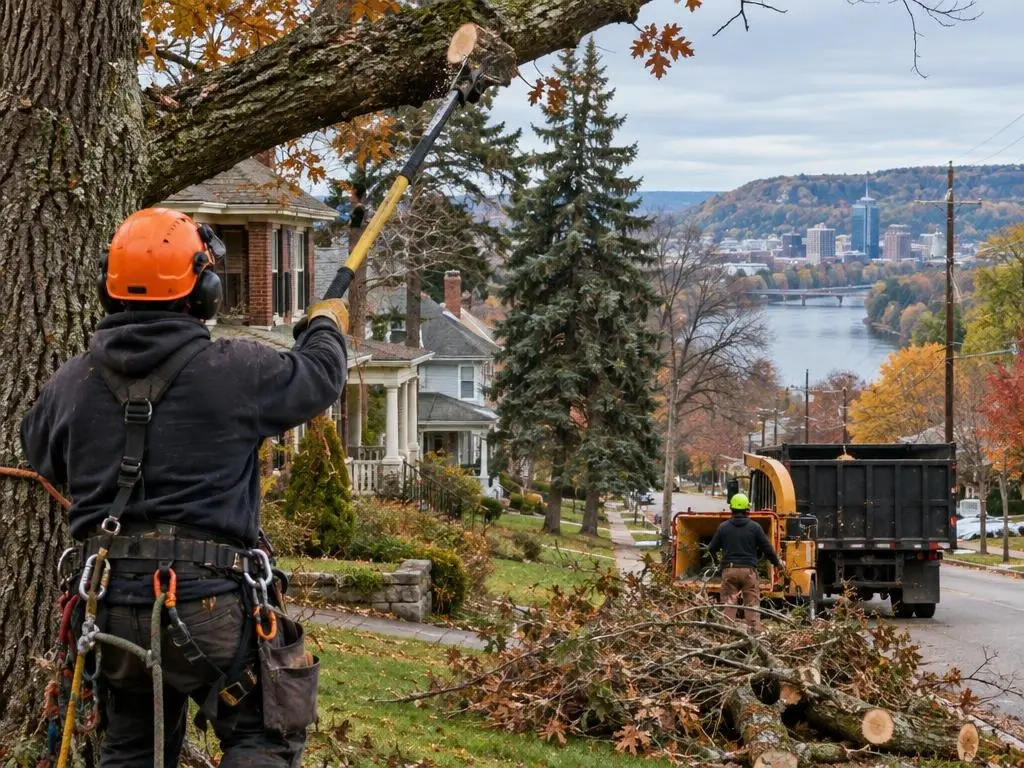
Tree removal on a typical Grand Rapids property is a piece-by-piece job. Older neighborhoods were built a century ago with houses close together, and the trees planted then are now 60 to 80 feet tall with limbs over two or three yards. Felling one in a single cut is rarely an option. Instead a climber, or a lift where one can reach, takes off limbs and then trunk sections from the top down, and anything heavy enough to damage a roof, a fence or a garden is lowered on ropes. What drives the time and the price is mostly what lies under the tree and how equipment can reach it.
Signs a tree should come out
Some cases are clear. A dead tree, a trunk with a long vertical crack, a large cavity or mushrooms at the base, a fresh lean with soil heaved up on one side, or roots cut by a sewer or foundation job all point toward removal. Other cases are judgment calls: a healthy silver maple that has simply outgrown a small backyard, a spruce that has lost its lower half, a tree whose roots keep lifting the driveway. We tell you what we see, and if pruning or cabling would deal with the problem for less, we say so.
Dead ash is a priority
Emerald ash borer was first found in Michigan in 2002 and reached Grand Rapids around 2007. The state says it has killed tens of millions of ash trees since then, and many dead or dying ash still stand in Kent County yards and along back fence lines. Look for D-shaped exit holes in the bark, patches where woodpeckers have stripped the outer bark, and crowns that thin from the top down. Dead ash dries out and becomes brittle, so it breaks unpredictably when climbed or rigged. An ash that can reach your house or the street is easier and safer to remove now than in two years.
Oaks, permits and the right-of-way
Removing an oak raises a timing question. Oak wilt spreads through fresh wounds in spring and early summer and through grafted roots between neighboring oaks, so if an oak is dying of wilt, the order of work matters and the wood needs careful handling. If the tree stands in the grass strip between the sidewalk and the street, it belongs to the City of Grand Rapids. The city issues a free permit for a homeowner to hire a company to remove it; the permit requires the stump to be ground and the right-of-way restored, and utilities must be located before grinding. We point this out before quoting so the permit is approved before work is scheduled.
When a crane or lift makes sense
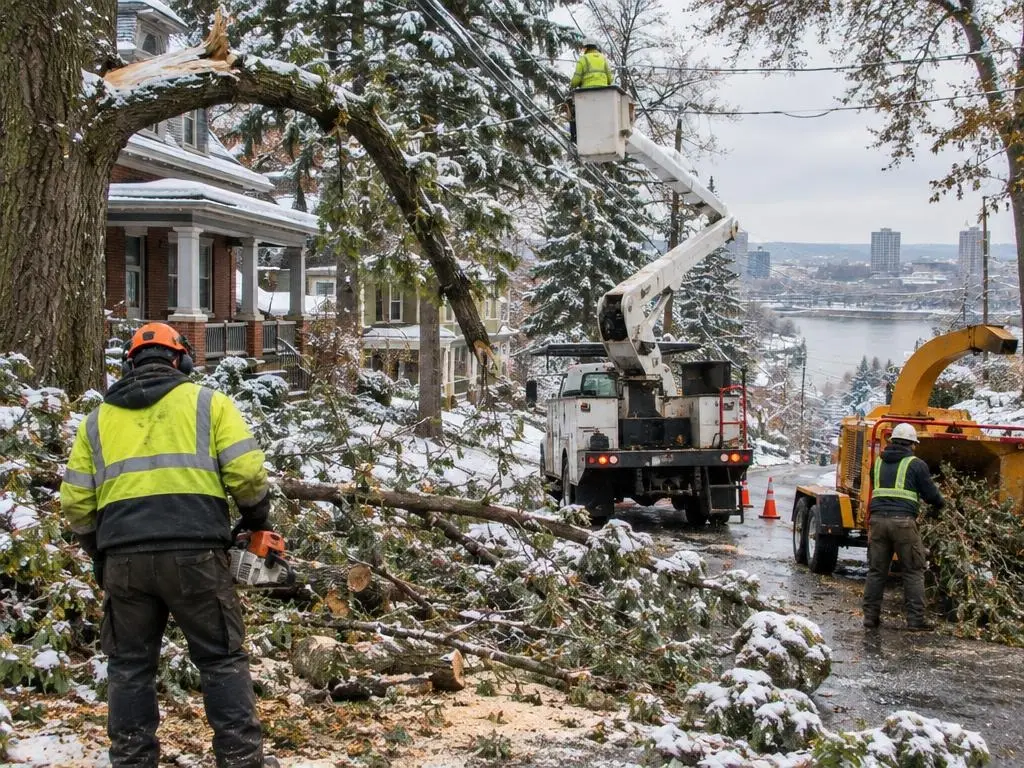
Most removals here are done with climbers, ropes and a chipper. A bucket truck saves time when it can park close. For a large dead tree over a house, or a tree in a fenced backyard with no side access, a crane can be the safest option because it lifts sections out instead of lowering them through the canopy. It costs more for the day but can shorten the job. We explain which method fits your site and why.
Wood, chips and the stump
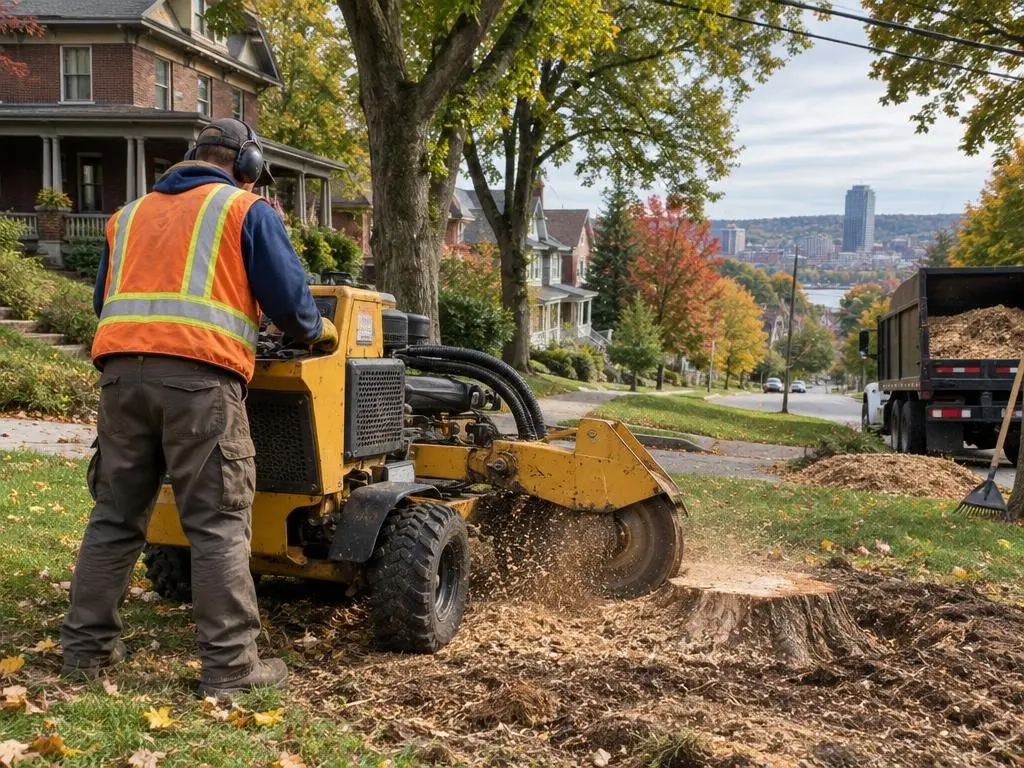
Grand Rapids curbside yard waste does not take logs, stumps or whole trees, so every removal needs a plan for the wood. You choose: rounds left for firewood, logs stacked, or everything hauled away, and chips left for your beds or taken off site. Keep oak and ash firewood local; state agencies ask people not to move firewood because that spreads pests. Stump grinding is its own line on the quote, so you can do it the same day, later or not at all.
What This Covers
Removal includes the tree itself and everything that comes off it.
Sectional removal
Limbs and trunk pieces cut from the top down and lowered on ropes where they cannot be dropped.
Dead ash and hazard trees
Ash killed by emerald ash borer and other dead or cracked trees taken down before they fail.
Street-tree removals by permit
City right-of-way trees removed once the homeowner's Grand Rapids Forestry permit is approved, with the stump ground as required.
Crane and lift removals
Lifting sections out over houses or fences when climbing alone would be slower or riskier.
Wood and brush handling
Brush chipped, logs left in rounds or stacked, or all of it hauled away.
How Much Tree Removal Runs
| Job | Published range |
|---|---|
| Medium tree, Grand Rapids (Homeyou) | $500 to $680 |
| Tree under 30 ft (HomeGuide, national) | $200 to $500 |
| Tree 30 to 60 ft (HomeGuide, national) | $500 to $1,500 |
| Tree 60 to 80 ft (HomeGuide, national) | $850 to $2,000 |
| Tree over 80 ft (HomeGuide, national) | $1,200 to $2,500+ |
| Ash tree (HomeGuide, national) | $650 to $2,000 |
| Crane service per day (Angi, national) | $250 to $600 |
Ranges from Homeyou's Grand Rapids cost page (2026), HomeGuide (2026) and Angi (2026). Angi notes hard-to-reach or unsafe sites can add 25% to 50%. Your written estimate is the price.
How We Do It
1. Site visit
We look at the tree, what is underneath it, the wires and how to get equipment in.
2. Ownership and permits
If the tree is in the city right-of-way, we explain the free Forestry permit before scheduling.
3. Written quote
Method, cleanup, wood handling, stump and price for each tree.
4. Removal
Limbs and sections come down in a planned order, lowered on ropes where needed.
5. Haul-off and cleanup
Brush chipped, wood left or hauled as agreed, and the yard raked and blown clean.
Why Choose Us for Tree Removal
Method explained
You know before the day whether a tree will be climbed, reached by lift or lifted by crane, and why.
Permits flagged
City street trees are identified at the first visit, not halfway through the job.
Tree Removal Questions
How much does tree removal cost in Grand Rapids?
Homeyou's 2026 Grand Rapids figures put a medium tree at about $500 to $680. National guides run from about $200 for a small, easy tree to $2,000 or more for a large one, and Angi says tight or unsafe sites can add 25% to 50%. We price each tree in writing after seeing it.
Can I remove the tree between my sidewalk and the street?
Not without a permit. That strip is city right-of-way in Grand Rapids, and the trees in it are city trees. The permit is free; the city reviews requests within two business days, and it requires the stump to be ground and the strip restored after removal.
Is it harder to remove a dead tree?
Usually. Dead wood, especially dead ash, can snap unpredictably, so climbing and rigging take longer and a lift is sometimes the safer choice. Angi notes that poor tree health can add up to about 15% to the cost. Removing a tree while it is still declining is generally easier than after it is fully dead.
Can you take down a tree that hangs over my neighbor's house?
Yes. Limbs over another property are cut in small pieces and lowered on ropes so nothing falls where it should not. It helps to let your neighbor know beforehand, since a climber or ground worker may need to step onto their side.
What can I do with the wood?
Keep it as firewood, have it stacked, or have it hauled away. The city's curbside program does not take logs or stumps, so we agree on the wood before the job. Burn ash and oak close to home rather than moving it.
Tree Removal Service Areas
- Tree Service in Grand Rapids, MI
- Tree Service in Wyoming, MI
- Tree Service in Kentwood, MI
- Tree Service in Walker, MI
- Tree Service in Grandville, MI
- Tree Service in East Grand Rapids, MI
- Tree Service in Rockford, MI
- Tree Service in Cedar Springs, MI
- Tree Service in Lowell, MI
- Tree Service in Ada, MI
- Tree Service in Cascade, MI
- Tree Service in Comstock Park, MI
- Tree Service in Byron Center, MI
- Tree Service in Caledonia, MI
- Tree Service in Sparta, MI
- Tree Service in Plainfield Township, MI
- Tree Service in Hudsonville, MI
- Tree Service in Jenison, MI
- Tree Service in Allendale, MI
- Tree Service in Coopersville, MI
- Tree Service in Zeeland, MI
- Tree Service in Middleville, MI
- Tree Service in Wayland, MI